內容簡介
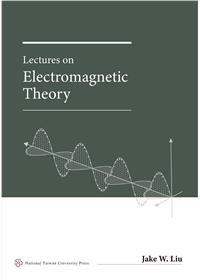
Lectures on Electromagnetic Theory provides a concise, self-contained introduction to graduate-level electromagnetic theory, organized for a one-semester course. Written in a "theoretical minimum" style, the text emphasizes clear physical insight and mathematical precision. The five chapters cover Maxwell equations and fundamental theorems; wave propagation, plane-wave expansion, and guided waves; electromagnetic radiation and Green functions; analytical scattering theory for canonical targets; and an introduction to relativistic electrodynamics linking classical electrodynamics with special relativity. The book serves both beginning graduate students and researchers seeking a compact reference.
Lectures on Electromagnetic Theory provides a concise, self-contained introduction to graduate-level electromagnetic theory, organized for a one-semester course. Written in a "theoretical minimum" style, the text emphasizes clear physical insight an
作者介紹
Jake W. Liu (劉人瑋) is currently an Assistant Professor in the Department of Electronic Engineering at National Taipei University of Technology. He received the Ph.D. degree from the Graduate Institute of Communication Engineering at National Taiwan University. His research interests include antenna measurement theory, phased-array calibration at millimeter-wave frequencies, and computational electromagnetics.
序
Preface
These lecture notes provide a concise yet self-contained treatment of graduate-level electromagnetic theory, organized into five chapters and intended for a one-semester course. This work does not attempt the feat of composing a full set of Large Prajñāpāramitā Sūtras; it merely tries to be a Heart Sūtra of its kind. The presentation follows a “theoretical minimum” style: rigorous enough to capture the essential physics and mathematics, while streamlined to serve both as a learning resource and as a quick reference.
The course begins with a review of Maxwell equations, fundamental theorems, and boundary conditions, establishing the foundation for all subsequent developments. Chapter 2 turns to wave propagation and transmission, introducing plane wave expansion, reflection and transmission at interfaces, and guided-wave phenomena in canonical waveguides. Chapter 3 addresses electromagnetic radiation, deriving fields from vector and scalar potentials, presenting the role of Green’s functions, and arriving at the Stratton–Chu formulation. Chapter 4 develops the theory of electromagnetic scattering, defining scattering cross sections and providing analytical treatments of canonical problems such as dielectric and perfectly conducting spheres. The notes conclude in Chapter 5 with an introduction to relativistic electrodynamics, connecting classical electromagneticswith special relativity.
These notes are written with two primary audiences in mind: graduate students beginning their study of electromagnetics, and researchers seeking a rapid but rigorous review of the field. While the material assumes familiarity with undergraduatelevel electromagnetics and vector calculus, key mathematical tools are introduced as needed. The style emphasizes clarity and physical insight, while maintaining mathematical precision. It is my hope that this text not only serves as a foundation for further study and research in electromagnetics, but also as a compact reference for revisiting the essentials when needed.
Although great care has been taken in preparing this manuscript, any remaining mistakes are entirely my own. Readers are kindly invited to point them out, and I will correct them with sincere gratitude—and perhaps mild embarrassment.
目次
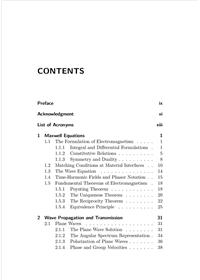
Preface
Acknowledgment
List of Acronyms
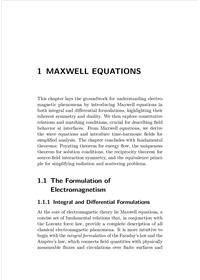
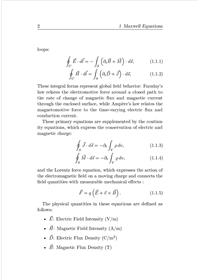
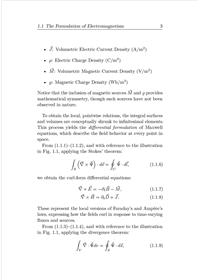
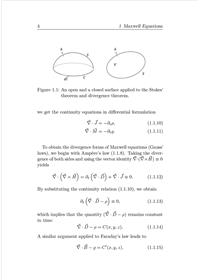
1 Maxwell Equations
1.1 The Formulation of Electromagnetism
1.2 Matching Conditions at Material Interfaces
1.3 The Wave Equation
1.4 Time-Harmonic Fields and Phasor Notation
1.5 Fundamental Theorems of Electromagnetism
2 Wave Propagation and Transmission
2.1 Plane Waves
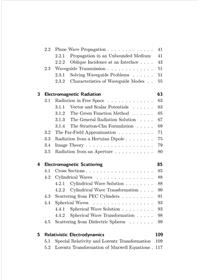
2.2 Plane Wave Propagation
2.3 Waveguide Transmission
3 Electromagnetic Radiation
3.1 Radiation in Free Space
3.2 The Far-Field Approximation
3.3 Radiation from a Hertzian Dipole
3.4 Image Theory
3.5 Radiation from an Aperture
4 Electromagnetic Scattering
4.1 Cross Sections
4.2 Cylindrical Waves
4.3 Scattering from PEC Cylinders
4.4 Spherical Waves
4.5 Scattering from Dielectric Spheres
5 Relativistic Electrodynamics
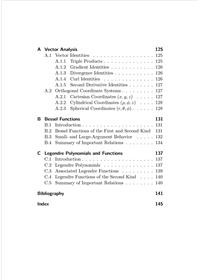
A Vector Analysis
A.1 Vector Identities
A.2 Orthogonal Coordinate Systems
B Bessel Functions
B.1 Introduction
B.2 Bessel Functions of the First and Second Kind
B.3 Small- and Large-Argument Behavior
B.4 Summary of Important Relations
C Legendre Polynomials and Functions
C.1 Introduction
C.2 Legendre Polynomials
C.3 Associated Legendre Functions
C.4 Legendre Functions of the Second Kind
C.5 Summary of Important Relations
Bibliography
Index