內容簡介
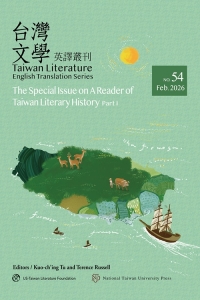
《台灣文學英譯叢刊》關注台灣文學作品及其脈絡,繼51期出版了葉石濤的開創性著作《台灣文學史綱》後,本輯再將洪淑苓教授主編的《臺灣文學史讀本》,分為兩期收錄,本期收錄洪教授的緒論和前七章。內容涵蓋晚明以來台灣的文學表達,並包含若干章節探討從有記載的歷史到現代的詩歌。
作者介紹
【About the Editors】
Kuo-ch'ing Tu, born in Taichung, Taiwan. His research interests include Chinese literature, Chinese poetics and literary theories, comparative literature East and West, and world literatures of Chinese (Shi-Hua wenxue). He is the author of numerous books of poetry in Chinese, as well as translator of English, Japanese, and French works into Chinese.
Terence Russell is Senior Scholar in the Asian Studies Center at the University of Manitoba. He has an interest in contemporary literature in Chinese, especially the literature of Taiwan's Indigenous people. Dr. Russell has been a regular contributor to Taiwan Literature: English Translation Series, and was the guest editor of Issue 24 on Taiwan Indigenous myths and oral literature.
Guest Editor
Shu-ling Horng holds a PhD in Chinese Language and Literature from National Taiwan University (NTU) and is currently a professor in the Department of Chinese Language and Literature at NTU. She previously served as director and adjunct professor at the Institute of Taiwanese Literature at NTU. Her research specializes in folklore, modern poetry, modern and contemporary literature, and women’s literature. She is the author of books such as The Skirt Hem of Thought: The Self-Inscription and Temporal Writing of Taiwan's Modern Women Poets.
序
〈臺灣文學史讀本專輯.上〉卷頭語
羅德仁
本特輯為本系列的第54期,標誌著本刊歷史的新階段。這是杜國清教授去年二月不幸逝世後,再度完整出版的期刊。杜教授是本刊近三十年的創始人和精神領袖。他的動力、靈感和支持,我們深切懷念,甚至難以想像沒有他,《台灣文學英譯叢刊》(TLETS)如何繼續存在。然而,我與杜教授多年密切合作,深知他強烈希望我們繼續他自1996年起開始的將台灣文學介紹給英文讀者的重要工作。我們也相信,儘管其他期刊也定期出版台灣文學的譯文,但杜教授在每一期《台灣文學英譯叢刊》(以下簡稱《叢刊》)中力求傳達的核心價值觀,使它脫穎而出,成為一份獨一無二的翻譯資源。因此,我們希望本期能成為《叢刊》生命的新起點,希望它會繼續呈現我們與杜教授共同的價值觀。
雖然第54期是在杜教授去世後才完成的,但它仍然在多個方面帶有他的印記。或許最重要的是,杜教授孜孜不倦地為期刊及其他相關計畫建立了獨立的資金來源。因此,我們擁有了美台文學基金會,該基金會現在由杜教授的兒子杜舒文代表,為期刊未來提供基本資金。我們也非常幸運能夠與國立臺灣大學出版中心建立牢固的合作關係,杜教授精心維護了這一關係,以確保未來出版的《叢刊》無論在紙本書還是數位版都達到最高標準。透過這種方式,杜教授不僅激勵我們繼續進行期刊工作,也為這項工作提供了實際的基礎。
本期及下一期的內容,亦由杜教授在辭世前決定。杜教授始終致力於確保期刊順利運作,不受影響,因此曾與國立臺灣大學的洪淑苓教授溝通,商討翻譯洪教授的《臺灣文學史讀本》一事。《臺灣文學史讀本》收錄了洪教授本人及多位年輕學者所寫的散文集,為早期台灣文學史提供了當代補充。由於《叢刊》已在第51期出版了其中一部譯作—葉石濤的開創性著作《台灣文學史綱要》,因此翻譯洪教授的《臺灣文學史讀本》(以下簡稱《讀本》)便成了順理成章的選擇。儘管我們無法再依賴杜教授來確保這個計畫的成功,洪教授還是同意我們繼續進行翻譯和編輯工作,這讓我們感到欣慰。這是我們非常欣賞的信念的展現。
由於《讀本》篇幅較長,且《台灣文學英譯叢刊》(TLETS)的頁數有限,我們的譯本將分為兩期。本期收錄了洪教授的緒論和前七章。下一期將收錄《讀本》第九
至第十六章。由於章節按年代和體裁排列,54期將涵蓋晚明以來台灣的文學表達,並包含若干章節探討從有記載的歷史到現代的詩歌。55期將更著重於戰後及當代文學,並依體裁分類。總而言之,洪教授的這本讀本一旦翻譯成英文,將為研究台灣文學發展的學生提供一份實用指南,幫助他們全面了解台灣的書面表達,其中包含大量在其他文獻中找不到的討論和詳細資訊。洪教授在導論中表明,她希望將本書置於早期建構台灣文學史整體框架的脈絡中解讀。為此,她簡要概述了台灣文學史的編纂學,始於20世紀40年代黃得時的著作,當時台灣仍處於日本統治之下。黃得時的重要之處在於,他參考了歐洲文學史家,尤其是法國學者伊波利特.阿道夫.泰納(Hippolyte Adolphe Taine)的觀點,提出了文學與其產生的人文、歷史和自然環境密不可分的原則。這個基本觀點被後來的文學史家,如陳少廷、葉石濤和彭瑞金進一步拓展。然而,黃得時反對日本帝國主義將台灣視為殖民前哨、僅作為日本「大陸」邊緣附屬物的觀點,而葉石濤和彭瑞金則反對將台灣邊緣化於大中國文學傳統的範圍中。葉和彭都煞費苦心地證明,恰恰相反,台灣文學有著獨立的歷史和精神。
二戰後,接管台灣的國民政府極力宣揚「台灣只是大中華地區一個微不足道的小部分」的觀念。學校裡的學生被灌輸這樣的觀念:中國歷史是他們的歷史,中國文學是他們的文學,他們應該以此為傲。學習台灣的歷史、文學和獨特的文化經驗,除了「地方性」歷史、文學、文化等之外,不被鼓勵,甚至被禁止。
1987年戒嚴結束後,台灣逐漸走向全面民主,這一切發生了巨大的變化。自1990年代以來,將台灣視為獨立於中國大陸的實體的研究日益成為主流和制度化。洪教授注意到這種深刻的轉變與文學息息相關,並指出這是她建構《讀本》的根本方法。
洪淑苓是台灣現代詩研究的權威之一。因此,她選擇撰寫《讀本》中幾章與詩歌相關的內容也就不足為奇了。本期,第六章探討戰後現代詩,第七章探討詩社的興衰與多元化發展,第八章則探討台灣女性詩人,皆由洪淑苓教授撰寫。這些文章提供了豐富的資訊和洞見。
第六章回顧了戰後時期由中國流亡到台灣的近代詩人所處的環境中所產生的緊張局勢,他們發現自己身處的環境深受日本文學思潮和傳統的影響,而日本文學思潮和傳統又深受歐洲文學發展的影響。第七章首先探討了台灣詩社的持續存在及其對詩歌發展整體輪廓的貢獻。台灣第一本詩社由沈光文於1685年創立。在整個前現代時期,此類組織促進了詩人和其他文人之間文學思想和作品的交流。在整個日治時期和戰後時期,不同的詩社也代表著不同的政治和美學意識形態,並在支持文化和社會運動方面發揮了重要作用。隨著台灣發展成為一個自由開放、民族認同感強烈、多元文化氛圍濃厚的社會,詩社的明顯政治色彩逐漸消退,取而代之的是文學實踐和美學的更加多元性。從現代主義到超現實主義,再到後現代主義,各種「主義」在過去和現在都在詩社和學術論壇的脈絡中爭論不休。
在擁抱更多元化和包容性的文化的台灣現代社會當中,很重要的一個面向是女性作家的認可度不斷提升。在《讀本》第八章中,洪淑苓將目光聚焦於眾多為台灣詩壇做出貢獻的優秀女詩人,尤其是在戰後與解嚴時期。洪淑苓根據這些詩人的出生時間將其分為四代,有時也根據其出生地和教育背景進行細分。第一代出生於1919至1938年之間,既包括在日本統治下的台灣出生並接受教育的詩人,也包括出生在中國、戰後移居台灣的詩人。第二代女詩人出生於1939至1950年之間,也包括在台灣出生的詩人和從中國移民過來的詩人。然而,這些詩人及其創作藝術在更大程度上受到戰後初期台灣在思想上更國際化環境的影響。因此,她們的詩歌帶有西方詩歌思潮和理論的印記。洪教授所稱的第三代女性詩人,出生於1951年至1970年之間,從她們身上也可觀察到類似情形。這些「嬰兒潮」詩人通常比前幾代人受教育程度更高,思想更成熟。她們的作品也涉及更廣泛的題材,較少傾向於探討情感生活和家庭等傳統的女性議題。最後,出生於1971年後的第四代女性詩人展現出更多元的風格和主題興趣。她們擺脫了傳統女性詩人慣用的意象和象徵手法,轉而追求個人化、獨特的生活表達。
第二章探討台灣早期古典文學,由國立台灣大學博士的莊怡文精心編撰。莊博士是台灣古典文學及日治時期文學的專家。她精彩地概述了台灣作為一個地理和文化實體,如何從17世紀起進入中國古典文學的想像,尤其是當台灣被捲入鄭成功等抵抗滿清占領的明朝遺民而進行的最後鬥爭時。我們觀察到台灣被視為蠻族的領地,所謂「番人」當中有的在荷蘭殖民統治下選擇更定居的農耕生活,但其中許多人仍然對中國占領他們的土地懷有敵意。儘管如此,許多早期中國學者和官員對這些「番人」原住民的生活表現出濃厚的興趣,並編纂了詳細的民族志,記錄「番人」的風俗習慣。與早期的歐洲探險家一樣,古典文人也對台灣的純粹美景印象深刻,對台灣風景的描繪成為他們古典詩歌的主要主題。
莊博士也是第三章的作者,該章探討了日治時期及戰後時期的文言文文學。我們在此觀察到,那些在日治時期留在台灣或從中國返回台灣的中國學者,儘管他們對日治時期在台灣的統治感到不滿,但他們與日本學者仍然有很多共同之處。在日本明治和大正時期(1868-1912/1912-1926),大多數受過教育的日本人都被教授閱讀和寫作文言文,儘管這種學習方式是日本獨有的,被稱為「漢文訓読」。這種「訓読」方便日人透過日語的發音和語法來理解文言文。無論如何,對文言文的熟悉使日本殖民統治者得以自然地進入台灣本地文壇,並以此作為獲得島內地方領導人信任和支持的手段。日本人參與並鼓勵本地的文學活動,包括詩社。總督府主辦了重要的文學聚會,邀請台灣和日本作家參加。這種互動大大促進了日治初期台灣殖民者與知識界領袖之間的良好關係。
第四章由陳允元博士撰寫,主要探討日本殖民時期初期台灣文學發生的深刻變化。在此期間,不僅來自世界各地的新想法被引入,書面表達媒介本身也引發了激烈的爭論。兩千年來,文言文一直是中國傳統文學的基礎,清朝被推翻以後此文化基礎卻被批判為過時、封建,不適合現代文學描寫。取而代之的是,以現代普通話用法和語法為基礎的「白話文」受到了那些致力於徹底實現中國現代化的人士的推崇。
在中國,1919年的五四運動標誌著文學界對古典傳統的強烈質疑。胡適在1917年發表的一篇文章中倡導向白話文的轉變,成為了五四運動後崛起的左翼作家群體的主要信條。這些作家和知識分子反抗中華帝國壓迫的社會和政治體制。相較之下,當時的台灣正處於日本的統治之下,而日本在社會和經濟改革方面已經取得了巨大的成功。因此,儘管20世紀20年代和30年代的台灣新文學
運動從五四運動中汲取了許多靈感,但它必然具有不同的意義。
陳博士描述了像張我軍和賴和這樣的年輕知識分子如何幫助引入五四運動的理念,但他們也意識到,在日本殖民統治下的台灣必須應對一系列獨特的問題。台灣新文學運動提倡在文學中使用白話文,具有明顯的左翼傾向,同時也帶有強烈的反殖民主義和本土主義元素,這些元素也存在於中國新文學中,但由於台灣的歷史經驗,這些元素略有不同。
正如全世界各地歷史上的現象一樣,台灣新文學運動興起於普遍的社會和文化變革時期。日本殖民政府首先致力於發展台灣的基礎設施,以促進島上自然資源的發展。然而,與其他殖民國家一樣,日本人意識到,他們必須依靠受過教育的本土人口才能實現其殖民計畫。這意味著台灣人不僅在島上的公立學校體系中接受現代日本教育,許多台灣人還前往日本就讀大學和技術學院。在日本
期間,這些年輕的台灣人常常從當地活躍的政治氛圍中獲得靈感,吸收左翼和民族主義思想。為此,許多學生組織了致力於抵抗日本殖民主義和增強台灣民族意識的團體。
台灣文學史與中國文學史的區別之一在於,在日治時期,許多接受過日語正式教育的台灣年輕人,選擇用這種「壓迫者的語言」來寫作。這也是世界各地許多被殖民者勢力壓倒後的民族做出的選擇。然而,使用壓迫者的語言並不意味著拒絕本土認同,屈服於殖民統治。一些最激進、最反殖民的文學作品是用日文創作的。本期刊之前登載了許多這類「台灣文學日文作品」的翻譯。
這時期的文學並非全部都受到反殖民主義和民族主義的啟發。相當一部分台灣作家對日本的文化和社會懷有敬仰之情。許多人積極參與日本或台灣的文學圈,希望得到殖民統治者的認可。還有一些人則能夠接觸到日本以外的文學和思想理念。日本人致力於國家徹底的現代化,通常意味著向西方國家學習。西方文學、歷史和哲學著作被大量翻譯成日語,台灣年輕人也樂於接受這些作品所呈現的創新和另類觀點。因此,包括未來主義、立體主義、達達主義和超現實主義在內的現代主義文學理論在這段時期進入了台灣文學界。
第五章,陳允元教授繼續探討20世紀30、40年代新文運動的命運。當時,東亞正處於戰火紛飛的時期,文學以及文學創作者都無法擺脫戰爭的陰影。為了最大限度地利用台灣的人力和自然資源,日本政府對台灣人民施加了越來越大的壓力,迫使他們更全面地融入日本社會,並認同日本的帝國主義目標。這種同化壓力的具體表現是皇民化運動。在這種體制下,台灣人被迫放棄本土文化和語言,成為效忠天皇的日本臣民。
不出所料,台灣對皇民化運動的反應褒貶不一,尤其是在菁英階層和受過良好教育的人群中。一些台灣人認為日本文化比他們的本土中國傳統更為先進,並樂於認同。另一些人則無法接受日本的帝國主義計畫,並試圖尋找抵制之道。其中一些抵制源於民族主義的擔憂,但也有人強烈反對日本政府為支持戰爭而推廣帶有說教或宣傳內容的文學作品。像呂赫若這樣的作家曾廣泛撰文反對使
用這類說教文學,但日本當局很快就壓制了這種情緒的表達。
戰爭時期最激烈的爭議莫過於所謂的「糞寫實主義」辯論。這與台灣作家在日本戰時政府的嚴格管制下所處的困境直接相關。日本當局希望台灣文學如同其殖民地其他地區一樣,能夠增強民眾對戰爭的支持,並號召全體國民投身於在日本領導下統一東亞的事業。如上所述,一些作家竭盡全力履行其宣傳職責,創作了一些矯揉造作的作品,宣揚愛國主義和為日犧牲的美德。然而,有些作
家不願屈服於政府壓力,而是以現實主義和「振興本土文化」的名義,創作了描寫鄉村日常生活或家族歷史的作品。忠於日本的作家和評論家認為這類作品無助於戰爭,並稱之為「糞寫實主義」。隨著戰爭的進行,那些試圖以更現實的方式描繪台灣生活的作家被擊敗了,獨立文學的任何剩餘創作空間都消失了。
第54期是《台灣文學英譯叢刊》的新起點。杜教授不在,我們必須靠自己開拓前進的道路,並建立新的標準來指導我們的工作。同時,我們致力於在本期及以後的所有期刊中秉持杜教授的基本編輯原則。我們堅信台灣文學的自主性和內在價值,並將肩負起向世界讀者推廣台灣文學的使命。台灣文學的未來,如同台灣本身的未來一樣,是光明的。我們致力於向世界展示這份光輝。
我衷心感謝眾多人士的支持,感謝他們為本書的成功出版做出了貢獻。首先,我要感謝洪淑苓教授對我以及叢刊其他出版團隊的信任。洪教授與杜老師在學術和個人層面都保持著非常密切的關係,我知道,在杜老師缺席的情況下,洪教授一定很難想像翻譯和出版這本她的《讀本》艱辛。我們希望最終成品能夠不辜負她的信任。
十年來,我們一直仰賴國立臺灣大學出版中心的支持和專業經驗,出版《讀本》。國立臺灣大學出版中心團隊協助排版、校對和叢刊的封面設計。如果沒有他們的幫助,我們不可能期望最終的成品能達到如此高品質的水準。我們也衷心感謝我們的譯者,他們持續提供高度忠實和易讀的文學翻譯。由於本期雜誌的高度學術性,我們的譯者尤其面臨挑戰,需要運用高水準的學術知識,準確反映《讀本》所涵蓋的各個主題的內容。在最初的編輯過程中,我們的英文文字編輯Fred Edwards繼續以他的經驗、智慧和耐心,為譯文的潤飾貢獻力量。最後,自杜教授過世以來,杜教授的兒子杜舒文(Lucian Tu)一直為本刊的工作提供指導和熱情支持。杜舒文接手了美台文學基金會的管理工作,儘管工作繁忙,他仍然慷慨地貢獻自己的時間和知識,幫助我們思考美台文學基金會的未來發展方向。我謹向杜舒文以及所有對本期刊重要工作給予大力支持的人致以最深切的謝意。
Foreword to the Special Issue on A Reader of Taiwan Literary History Part I
Terence Russell
T his issue, the fifty-fourth in the series, marks a new stage in the history of our journal. It is the first issue to be entirely produced since the untimely passing Professor Kuo-ch’ing Tu in February in early 2025. Professor Tu was the founder and guiding spirit of this journal for almost thirty years. His drive, inspiration and support are, of course, deeply missed, to the point that it was very difficult to imagine the continued existence of Taiwan Literature: English Translation Series (TLETS) in his absence. However, having worked closely with Prof. Tu for many years, I know it was his strong wish that we continue the important work of introducing Taiwan literature to the English reading public that he began in 1996. We also believe that, although there are other journals that publish translations of Taiwan literature on a regular basis, the core values that Prof. Tu sought to convey in every volume of TLETS set it apart and make it uniquely valuable as a translation resource. So it is that we hope this issue will be a new beginning in the life of a journal that represents values that we share with Prof. Tu.
While Issue Fifty-four has been entirely produced since Prof. Tu’s passing, it still bears his imprint in more than one way. Perhaps most importantly, Prof. Tu worked tirelessly to establish an independent funding source for the journal and other related projects. As a result, we have the US-Taiwan Literature Foundation, now represented by Lucian Tu, which will provide the basic funding for many issues of the journal to come. We also are very fortunate to be able to rely upon a strong relationship with National Taiwan University Press, a relationship that Prof. Tu cultivated so as to ensure that future issues of TLETS are produced to the highest standards both in print and online. In this way, not only has Prof. Tu inspired us to continue the work of the journal, he provided the tangible basis upon which that work can be done.
The content of this issue, and the next, were also determined by Prof. Tu prior to his passing. Always anxious to ensure that the journal could move forward smoothly and without interruption, he had for some time been in communication with Professor Shu-ling Horng of National Taiwan University, with the idea of translating Prof. Horng’s A Reader of Taiwan Literary History (Taiwan wenxueshi duben) for the journal. Prof. Horng’s Reader is a collection of essays, written by herself and by a number of younger scholars, that provides a contemporary supplement of the various earlier histories of Taiwan literature. Since TLETS published a translation of one of those histories, Yeh Shih-t’ao’s pioneering An Outline History of Taiwan Literature, as Issue Fifty-one, a rendering of Prof. Horng’s Reader seemed a natural choice. To our great relief, despite no longer being able to rely upon Prof. Tu to ensure the successful production of this project, Prof. Horng consented to allow us to proceed with the work of translation and editing. This is a demonstration of faith that we greatly appreciate.
Due to the length of the Reader and the page limits of TLETS, our translation will have to be divided into two separate issues, the first presenting Prof. Horng’s Introduction and the first seven chapters. The second volume will include Chapters Nine through Sixteen. Since the chapters are arranged according to chronology and genre, this first installment deals will literary expression in Taiwan from the late Ming period, and includes a number of chapters on poetry from earliest recorded history to the modern era. The issue to follow will be more concerned with postwar and contemporary literature, dealt with according to genre. In all, Prof. Horng’s Reader, once translated into English, should provide students of Taiwan’s literary development with a useful guide to the full sweep of written expression on the island, offering much discussion and detailed information not found in other sources.
In her Introduction, Prof. Horng signals her intention that the Reader should be seen in the context of earlier attempts to create an overall framework of Taiwan’s literary history. To this end, she provides a brief outline of the historiography of Taiwan’s literature, beginning with the work of Huang Deshi from the 1940s while Taiwan was still under Japanese rule. Huang is important because he referenced European literary historians, particularly French scholar Hippolyte Adolphe Taine, in advancing the principle that literature cannot be disassociated with the human, historical and natural environment in which it is produced. This fundamental view was further expanded by later literary historians, like Chen Shao-ting, Yeh Shih-t’ao and Peng Jui-chin. However, whereas Huang was arguing against the Japanese imperial view of Taiwan as a colonial outpost, only significant as a peripheral adjunct to the Japanese “mainland,” Yeh and Peng argued against the view that Taiwan as marginal to the great Chinese literary tradition. Both Yeh and Peng took pains to demonstrate that, on the contrary, the literature of Taiwan has a history and an ésprit independent of China.
The narrative that Taiwan was but a small and insignificant part of Greater China was promoted strongly by the Chinese Nationalist government that took over the administration of Taiwan after World War II. Students in school were taught that the history of China was their history, and the literature of China was their literature, something that they should take great pride in. The study of the history, literature and unique cultural experience of Taiwan was not encouraged or even allowed except as “provincial” history, literature, culture, etc.
This all changed dramatically with the end of martial law in 1987, which was accompanied by gradual movement toward fully democratic government. Since the 1990s the study of Taiwan as an entity separate from China has become increasingly mainstream and institutionalized. Horng Shu-ling notes this profound realignment as it pertains to literature, indicating that it is fundamental to her approach to constructing her Reader.
Horng Shu-ling is one of the leading authorities on modern poetry in Taiwan. It is thus not surprising that she would choose to author several of the chapters in the Reader which deal with poetry. In this issue, Chapter Six on postwar modernist poetry, Chapter Seven dealing with the rise and fall of poetry societies and increased plurality, and Chapter Eight devoted to women poets in Taiwan, were all written by Prof. Horng. These essays provide a trove of information and insight.
Chapter Six looks back on the tension that arose in the postwar era as recent emigré poets from China found themselves in an environment strongly shaped by Japanese literary trends and traditions, which in turn had been influenced heavily by developments in European literature. Chapter Seven first takes a look at the persistent existence of poetry societies in Taiwan and their contributions to the overall contour of poetic development. The first poetry society in Taiwan was formed in 1685 by Shen Guangwen. Throughout the pre-modern era, such organizations facilitated the sharing of literary ideas and works among poets and other literati. Throughout the Japanese period and postwar era, different poetry societies also came to represent various political and aesthetic ideologies and were instrumental in supporting cultural and social movements. As Taiwan developed into a free and open society with a strong national identity and a commitment of plurality, the overtly political timbre of poetry societies faded somewhat, to be superseded by greater diversity of literary practice and aesthetics. Various “-isms” from Modernism, to Surealism, and Post-moderism were, and still are, debated within the context of poetry societies and academic fora.
One of the most important aspects of Taiwan’s embrace of greater cultural diversity and inclusion has been an increased recognition of the important work of women authors. In Chapter Eight of the Reader, Horng Shu-ling turns her attention to the many excellent female poets who have contributed Taiwan’s poetry scene, especially in the postwar and post-martial law eras. Horng divides these poets into four distinct generations according to their time of birth, but sometimes subdivided according to their place of birth and educational background. The first generation, born between 1919 and 1938, include poets who were born and educated in Taiwan under Japanese rule, as well as those who were born in China and migrated to Taiwan after the war. Generation Two, born between 1939 and 1950, also includes those born in Taiwan, and those who emigrated from China. However, to a much greater extent, these poets and their creative art were influenced by the more internationalized intellectual realm of Taiwan in the immediate postwar era. As a consequence, their poetry bears the imprint of Western poetic trends and theories. Similar observations can be made about the third generation of female poets identified by Prof. Horng, those born between 1951 and 1970. These “boomer” poets generally better educated and more ideologically sophisticated than earlier generations. Their work also engages with a broader range of material, and is less inclined to explore traditionally feminine concerns such as emotional life and family. Finally, the fourth generation of female poets, born after 1971, demonstrate an even greater range of styles and thematic interests. They have moved away from imagery and symbolism traditionally associated with women poets in favor of personal and unique representations of life.
Chapter Two, on early classical literature in Taiwan has been ably compiled by Yi-wen Chuang, a graduate of National Taiwan University and expert on classical literature in Taiwan, and literature during the period of Japanese rule. Dr. Chuang provides an excellent overview of how Taiwan, as a geographical and cultural entity, entered the classical Chinese imaginary beginning in the seventeenth century, especially as the island was drawn into the final struggles of Ming dynasty loyalists like Zheng Chenggong (Koxinga) to resist the Manchu Qing takeover of the Chinese homeland. We observe how Taiwan was viewed as a realm of barbarians, some of whom had adopted a more sedentary agrarian life under Dutch colonial rule, but many of whom remained hostile to Chinese occupation of their lands. Nonetheless, many early Chinese scholars and officials took a strong interest in the lives of these “barbarian” Indigenous peoples, compiling detailed ethnographies of their customs. Like earlier European explorers, classical literati were also impressed with the sheer beauty of Taiwan and depictions of the island’s scenery became a major theme in their classical verse.
Dr. Chuang is also the author of Chapter Three, which looks at literature in classical Chinese (wenyanwen) during the Japanese colonial era and into the postwar period. Here we observe that those Chinese scholars who remained, or returned to, Taiwan after the Japanese takeover found much in common with their Japanese counterparts, however much they may have resented the latter’s dominance of the island. During the Meiji and Taishō reign periods in Japan (1868-1912/1912-1926) most educated Japanese were taught to read and compose classical Chinese, albeit in the uniquely Japanese manner known as Kambun kundoku which allowed for an understanding of classical Chinese through Japanese pronunciation and grammar. In any case, this familiarity with classical Chinese, gave the Japanese colonial rulers a natural entré into local Taiwanese literati circles, something that they exploited as a means to gain the trust and support of local leadership on the island. The Japanese participated in and encouraged local literary activities including poetry societies. The Governor-General sponsored important literary gatherings involving both Taiwanese and Japanese writers. Such interaction greatly assisted in facilitating smooth relations between the colonial overlords and educated community leaders in Taiwan during the early period of Japanese rule.
In Chapter Four, written by Yun-yuan Chen, the profound changes that took place in Taiwan’s literature during the early Japanese colonial era are the main topic of discussion. During this time, not only were new ideas introduced from other parts of the world, the very medium of written expression was the subject of heated debate. Classical Chinese, which had formed the basis of traditional literate culture in China for over two thousand years, was attacked as antiquated, feudal, and unsuitable for modern literary discourse. In its place, vernacular Chinese, baihua, based on modern Mandarin usage and grammar, was advocated by those intent on modernizing China from the ground up.
In China, the May Fourth Movement of 1919 signaled a period of intense interrogation of classical traditions in literature. The transition to the use of baihuawen, famously advocated by Hu Shi in an article published in 1917, became a major tenet of the mostly leftist writers who came to prominence in the wake of May Fourth. Those writers and intellectuals struggled against the oppressive social and political systems of imperial China. By contrast, Taiwan was governed by Japan, which had already been very successful in reforming its society and economy. Thus though the Taiwanese New Literature Movement of the 1920s and 1930s took much inspiration from the May Fourth Movement, it necessarily took on different meaning.
Dr. Chen describes how it was young intellectuals, like Zhang Wojun and Lai He who helped introduce the principles of the May Fourth Movement to Taiwan, but who also recognized that Taiwan under Japanese colonial rule had to deal with a number of issues unique to the island. The Taiwanese New Literature Movement advocated the use of vernacular language in literature and had a distinctly leftist orientation, it also had strongly anti-colonial and nativist elements also present in Chinese new literature, but which, because of Taiwan’s historical experience, were nuanced differently.
As is almost always the case throughout world history, the New Literature Movement in Taiwan arose as part of a period of general social and cultural change. The Japanese colonial administration was first and foremost intent on developing the infrastructure in Taiwan which would facilitate the exploitation of the island’s natural resources. However, as will other colonial powers, the Japanese realized that they would have to rely upon an educated native population in order to carry out their colonial project. This meant that not only did Taiwanese receive modern Japanese educations in the public school system on the island itself, many Taiwanese also traveled to Japan to enroll in universities and technical colleges. While in Japan, these young Taiwanese often found inspiration in the lively political atmosphere there, absorbing leftist and nationalist ideology. In response, many students organized groups devoted to resisting Japanese colonialism and strengthening Taiwanese national consciousness.
One of the things that separates the history of Taiwan literature that of China is that during the Japanese period, many young Taiwanese, having received all of their formal education in Japanese language, chose to write in that “language of the oppressor.” This is a choice made by many colonized people around the world who find their native cultural traditions overwhelmed by colonial power. Making use of the oppressor’s language did not, however, mean rejecting native identity and succumbing to colonial domination. Some of the most radical and anti-colonial literature was written in Japanese. The journal has presented many examples of this writing in earlier volumes.
Not all literature from this era was inspired by anticolonialism and nationalism. There were significant numbers of Taiwanese authors who felt an admiration for Japanese cultural and society. Many actively participated in literary circles in Japan, or in Taiwan, with hopes of receiving acceptance by their colonial rulers. Still others were able to access literary and intellectual ideas from outside of Japan. The Japanese were dedicated to the complete modernization of their nation and this usually meant learning from Western nations. Western literature, history and philosophy works were widely available in Japanese translation, and young Taiwanese were open to the innovative and alternative views that they presented. Modernist theories of literature, including Futurism, Cubism, Dadaism and Surrealism thus found their way into Taiwanese writing during this period.
In Chapter Five, Yun-yuan Chen continues with the fate of the New Literature Movement during the 1930s and 1940s. This was a time heavily colored by war in East Asia, and literature, as well as those who wrote it could not escape war’s shadow. In order to make the greatest use of the human, as well as natural resources of Taiwan, the Japanese administration applied ever greater pressure on the people of Taiwan to assimilate more fully into Japanese society, as well as to identify with Japanese imperial objectives. The programmatic manifestation of this assimilative pressure was the Kōminka or “Imperial subjects” movement. Under this regime, Taiwanese were pushed to give up their native culture and language and become fully Japanese subjects loyal to the emperor.
As might be expected, reaction to the Kōminka Movement in Taiwan was mixed, especially among the élite and well-educated. Some Taiwanese recognized Japanese culture as more advanced than their native Chinese traditions and were happy to identify with it. Others could not accept the Japanese imperialist project and looked for ways in which to resist it. Some of that resistance stemmed from nationalistic concerns, but there was also a strong rejection of the Japanese administration’s promotion of literature with didactic, or propagandistic content in support of the war effort. Authors like Lü Heruo wrote extensively against the use of such didactic literature, but the Japanese authorities were quick to suppress the expression of such sentiments.
The most heated controversy during the war period was over so-called “shit-realism.” This was directly related to the dilemma that Taiwanese writers found themselves in under the strict control of Japanese wartime administration. The Japanese authorities hoped that literature in Taiwan, as elsewhere in their colonial holdings, would serve to bolster support for the war effort and rally the general citizenry to the cause of uniting all of East Asia under Japanese leadership. As mentioned above, some writers did their best to perform their propagandistic duties and produced stilted works demonstrating the virtues of patriotism and sacrifice for the Japanese cause. Other writers, however, did not wish to bow to government pressure and instead produced works about everyday life in the countryside, or family histories in the name of realism and “revitalizing local culture.” Writers and critics faithful to Japan rejected this work as unhelpful to the war effort and labeled it “shit-realism.” As the war progressed, those remaining writers who sought to portray life in Taiwan in more realistic terms were defeated and any remaining creative space for independent literature disappeared.
Issue 54 is a new beginning for Taiwan Literature: English Translation Series. In Professor Tu’s absence we must forge our own way forward and establish new standards to guide our work. At the same time, we are committed to maintaining Prof. Tu’s fundamental editorial principles in this and all future issues. We strongly believe in the autonomy and intrinsic value of Taiwan literature, and we will take up the mission of introducing that literature to world audiences. The future of Taiwan literature, like the future of Taiwan itself, is bright. It is our intention to demonstrate that brilliance to the world.
I am extremely grateful for the support of so many people who have contributed to the successful production of this volume. First and foremost, I want to thank Professor Shu-ling Horng for placing her trust in me and the rest of the journal’s production team. Prof. Horng had a very close scholarly and personal relationship with Prof. Tu, and I know that must have been difficult for her to imagine the translation and publication of her Reader in his absence. We hope that the final product will be worthy of her trust.
For the past ten years, we have relied upon the support and expertise of National Taiwan University Press in the publication of TLETS. The team at NTU Press assists with formatting, proofreading, and cover design. We could never hope for a final product of such high quality without their help. Our gratitude also goes to our translators who continue to provide literary renderings of the highest fidelity and readability. Because of the highly scholastic nature of the present issue, our translators have especially been challenged to exercise a high degree of scholarly knowledge in accurately reflecting the content of the various topics covered in the Reader. In the initial editorial process, our English copy-editor Fred Edwards continues to lend his experience, wisdom and patience to the polishing of the translated texts. Finally, since the passing of Prof. Tu, Lucian Tu, Prof. Tu’s son, has been a constant source of guidance and enthusiastic support for the work of the journal. Lucian has taken over the administration of the US-Taiwan Literature Foundation and, despite his busy work schedule, has given generously of his time and knowledge as we consider the future direction of the TLETS. To Lucian, and to all those who have expressed their strong support for this journal’s important work, I express my deepest gratitude.
目次
Foreword to the Special Issue on A Reader of Taiwan Literary History Part I╱Terence Russell
〈台灣文學史讀本專輯.上〉卷頭語╱羅德仁
Chapter 1: Introduction: Constructing a “History of Taiwan Literature”╱Shu-ling Horng
緒論:「臺灣文學史」的建構╱洪淑苓
Studies
Chapter 2: Classical Literature in Taiwan during the Ming-Zheng Regime and the Qing Dynasty明鄭至清領時期的臺灣古典文學╱Yi-wen Chuang
Chapter 3: The History of Classical Chinese Literature in the Japanese Colonial and Postwar Eras日治至戰後時期的古典文學史╱Yi-wen Chuang
Chapter 4: Taiwanese New Literature in the Japanese Colonial Era (I) 日治時期的臺灣新文學(I)╱Yun-yuan Chen
Chapter 5: Taiwanese New Literature in the Japanese Colonial Era (II) 日治時期的臺灣新文學(II)╱Yun-yuan Chen
Chapter 6: The Development of and the Debates Surrounding Postwar Modernist Poetry戰後現代詩的發展與論戰╱Shu-ling Horng
Chapter 7: The Rise and Fall of Poetry Societies and Postmodern Pluralism 詩社興替與後現代多元╱Shu-ling Horng
Chapter 8: Modern Female Poets and Female Poetics現代女詩人與女性詩學╱Shu-ling Horng
About the Editors
About the Authors
About the Translators
About Subscriptions